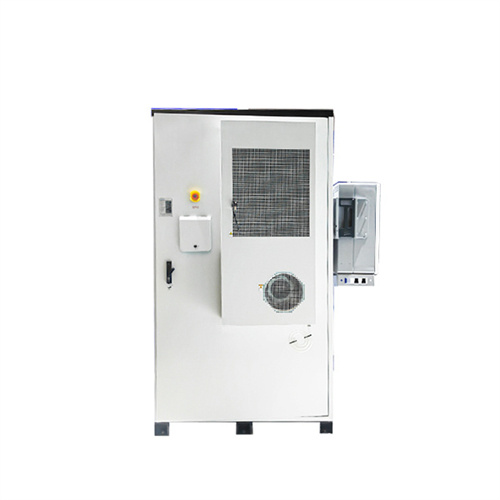
Inverters used in photovoltaic applications are historically divided into two main categories: 1. Standalone inverters 2. Grid-connected inverters Standalone inverters are for the applications where the PV plant is. .
Let’s now focus on the particular architecture of the photovoltaic inverters. There are a lot of different design choices made by manufacturers that create huge differences betw. .
The first important area to note on the inverter after the input side is the maximum power point tracking (MPPT) converter. MPPT converters are DC/DC converters that have the spe. .
The most common method to achieve the MPPT algorithm’s continuous hunting for the maximum power point is the “perturb and observe” method. Basically, with a predefined frequ. .
Next, we find the “core” of the inverter which is the conversion bridge itself. There are many types of conversion bridges, so I won’t cover different bridge solutions, but focus instead on.
[pdf] 
Inverters used in photovoltaic applications are historically divided into two main categories: 1. Standalone inverters 2. Grid-connected inverters Standalone inverters are for the applications where the PV plant is not connected to the main energy distribution network. The inverter is able to supply electrical energy to. .
Let’s now focus on the particular architecture of the photovoltaic inverters. There are a lot of different design choices made by manufacturers that create huge differences between the. .
The first important area to note on the inverter after the input side is the maximum PowerPoint tracking (MPPT) converter. MPPT converters are DC/DC converters that have the. .
Next, we find the “core” of the inverter which is the conversion bridge itself. There are many types of conversion bridges, so I won’t cover different bridge solutions, but focus instead on the bridge’s general workings. In Figure 2, a. .
The most common method to achieve the MPPT algorithm’s continuous hunting for the maximum PowerPoint is the “perturb and observe” method.. .
A solar inverter or photovoltaic (PV) inverter is a type of which converts the variable (DC) output of a into a (AC) that can be fed into a commercial electrical or used by a local, electrical network. It is a critical (BOS)–component in a , allowing the use of ordinar.
[pdf] True power (defined by P), measured in Watts – The actual amount of power used or dissipated in a circuit. Reactive power (defined by Q), measured in Volt-Amperes reactive (VAR) – The power resulting from inductive and capacitive. .
Example of rates in DACH Example of rates in North America .
For residential, the electric company usually charges for true power only. For residential systems, electricity bills are calculated based on kWh, which is the amount of real power. .
Apparent power values (S – measured in Volt-Amperes) can be calculated by measuring the current [using an ammeter (Ampere Meter) or a regular Digital multimeter (DMM)] and multiplying it by the grid’s voltage..
[pdf]