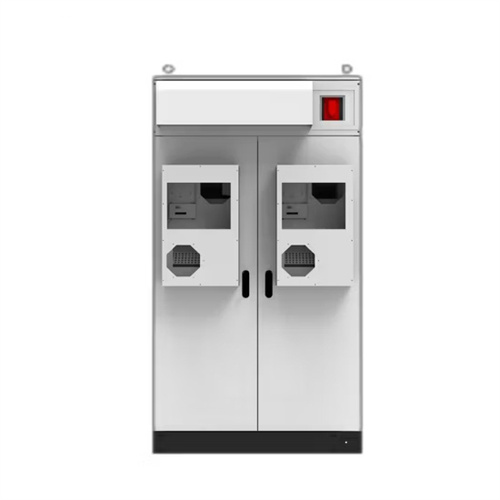
Self-Sufficiency– Battery energy storage systems aren’t simply appealing to renewable energy providers. Forward-thinking enterprises are also adopting them. Energy purchased during off-peak hours can be stored using battery storage systems. It can be activated to distribute electricity when tariffs are at their. .
Installing BESS necessitates a significant capital outlay – Due to their high energy density and enhanced performance, battery energy storage.
[pdf] 
Fabrication of new high-energy batteries is an imperative for both Li- and Na-ion systems in order to consolidate and expand electric transportation and grid storage in a more economic and sustainable way. Curr. .
••Optimization of new anode materials is needed to fabricate high-e. .
Nowadays, batteries have become an integral part of our daily life with many portable applications but there still are limitations like the limiting processes that occur in anodes (. .
In the search for high-energy density Li-ion batteries, there are two battery components that must be optimized: cathode and anode. Currently available cathode materials for Li-io. .
Regarding Na-ion batteries, the anode material is also the limiting step to build high-energy density commercial cells. The usual material of choice as anode for these systems is a diso. .
Two possible high-energy density anode materials have been revised for LIBs and NIBs. In the case of LIBs, Si-based anodes have been more thoroughly studied and present both high.
[pdf] Microgrids with high shares of variable renewable energy resources, such as wind, experience intermittent and variable electricity generation that causes supply–demand mismatches over multiple timescales.. .
••Hybrid LIB-H2 storage achieves lower cost of wind-supplied microgrid. .
AbbreviationsAC
Annualized cost
CAPEX
Capital expenditure
El
Electrolyzer
FC
Fuel cell
H2
Hydrogen
HS
Hydrogen storage
LIB
Lithiu. .
Microgrids, which currently provide electricity to 47 million people across 134 countries and territories, are likely to play an increasing role in future power systems. By 2030, the Wor. .
2.1. DemandThis paper analyzes a completely grid-isolated microgrid in the Greater Toronto Area that is supplied entirely by wind energy and serve. .
Fig. 1 outlines each step of the methodology. First, we compiled the input data, including technology parameters (cost, efficiency, lifetime, etc.), hourly wind speed data, and.
[pdf]